

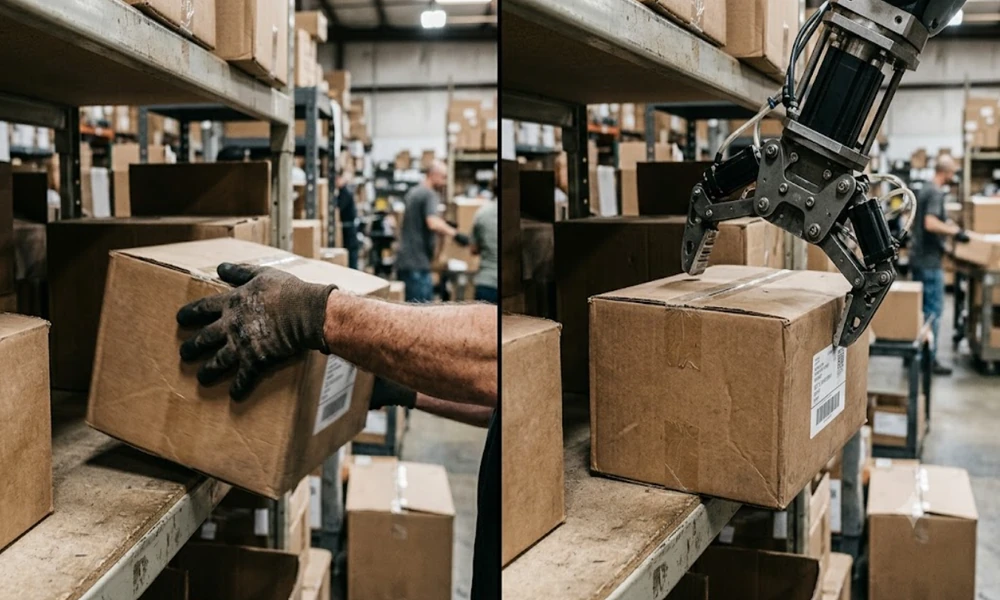
Physical AI is artificial intelligence that senses, decides, and acts in the real world through machines like robots, vehicles, and drones. It learns from synchronized recordings of physical activity, not text scraped from the web. Here are the nine answers technical buyers need before committing a budget to a training run.
Quick answers, all nine
- Physical AI is AI that acts on the world through hardware, not just screens
- Embodied AI is the research field. Physical AI is what ships
- No internet scale dataset of physical experience exists. It has to be collected
- The learning signal is fused sensor data: camera, IMU, audio, kinematics
- Simulation alone leaves a performance gap that shows up as broken objects
- The market runs from 7.11 billion dollars in 2026 to a projected 34.89 billion by 2031
- Logistics deploys first, and half the market sits in Asia Pacific
- Good data is defined by provenance, QC discard rates, and clean licensing
- Five vendor questions predict your eval lift better than any sales deck
1. What is physical AI in plain terms?
Physical AI is intelligence embedded in a machine that perceives its environment through sensors and changes it through motors, wheels, and grippers.
A language model predicts the next token. Physical AI predicts the next contact. How much force a jar lid needs. How a box shifts when the forklift turns. A single robot arm can carry 7 degrees of freedom, and every joint needs torque values the model has to get right on the first try. Screens forgive errors. Warehouses do not. That difference drives everything else in this list, starting with where the training signal comes from.
Why it matters: You are not buying model weights. You are buying behavior in the physical world, and physical errors cost hardware, product, and sometimes safety incidents.
2. How is physical AI different from embodied AI?
Embodied AI is the research field studying intelligence that lives in a body. Physical AI is the industry term for the deployed systems that come out of it.
You will see the terms swapped freely, and for buying decisions the label matters less than the data implications, which are identical. NVIDIA popularized “physical AI” for the commercial wave. Academia still says “embodied.” If you want the research lineage, read the complete guide to embodied AI on this blog. If you are scoping a deployment, keep reading here.
Why it matters: Vendors quote papers using one term and sell products using the other. Knowing they describe the same data problem keeps your evaluation honest.
3. Why did the internet era end before physical AI began?
Language models pretrained on trillions of scraped tokens. No equivalent archive of physical experience exists, so physical AI cannot be pretrained the same way.
There is no dataset of a kitchen being cleaned. No recording of a car assembled by hands that know exactly how much force each joint requires. The largest open robotics dataset, Open X-Embodiment, holds roughly 1 million trajectories across 22 robot embodiments. Set that against the web scale corpora behind large language models and the shortage is obvious. The data has to be created, on purpose, in real environments, which is why training data for robotics is its own discipline now.
Why it matters: Your data budget buys collection and validation, not scraping. Plan procurement timelines around capture, not download speeds.
4. What data does physical AI actually learn from?
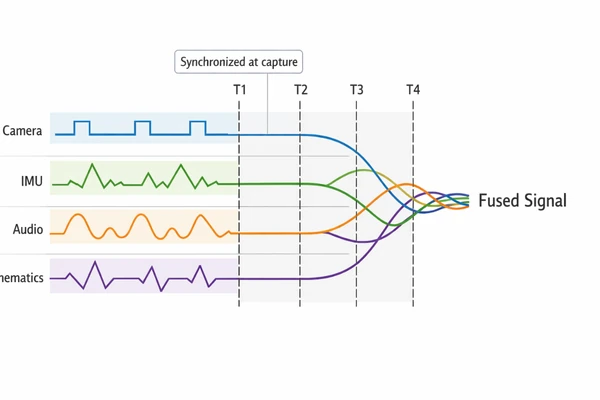
It learns from multi sensory recordings of human activity: camera, IMU, audio, and kinematics captured as one synchronized signal. This fused signal is what separates usable physical AI training data from stitched together footage.
Synchronization has to happen at capture, not in post. Align streams afterward and you introduce timing drift the model learns as physics. Mature pipelines record 6DoF pose, hand skeletal tracking, and joint torque in the same episode, then ship in training ready formats like MCAP, RLDS, and LeRobot v3. A child catching a ball hears it, tracks it, and feels their feet shift at once. The training signal should look the same.
Why it matters: Ask any vendor when their streams get synchronized. “In post processing” is a different product than “at capture,” and your model will feel the difference.
5. What is the sim to real gap and what does it cost?
The sim to real gap is the performance drop a model suffers when it leaves simulation and meets actual friction, lighting, and sensor noise.
Simulation gives you scale and safety. It does not give you the variance of a wet floor, a flickering fluorescent tube, or a cardboard box that got rained on. World models narrow the gap by learning to predict physical outcomes, but they train on real recordings too. The practical pattern in 2026 is hybrid: pretrain broadly in simulation, then close the gap with real world episodes. Skip the second step and the gap shows up as failed grasps and damaged inventory.
Why it matters: Every point of gap converts directly into failed picks and rework on your deployment floor. Real world data is the cheapest place to pay for it.
6. How big is the physical AI market right now?
Mordor Intelligence sizes the physical AI market at 7.11 billion dollars in 2026, reaching a projected 34.89 billion by 2031 at a 37.46 percent compound annual growth rate.
The capital is following the hardware. Goldman Sachs projects humanoid robotics investment passing 50 billion dollars by 2030. 1X opened a vertically integrated humanoid factory in Hayward, California in April 2026, built to produce 10,000 NEO home robots a year at 20,000 dollars each, with consumer shipments starting late 2026. Estimates vary across analysts because the category boundaries are still forming, so treat any single number as a directional signal, not gospel.
Why it matters: Compute and hardware budgets are exploding while verified training data supply stays thin. Data is the constraint your competitors have not solved yet.
7. Where does physical AI deploy first?
Logistics and supply chain holds the largest vertical share in 2026, with manufacturing, healthcare, and household robots behind it.
Geography matters more than most roadmaps admit. MarketsandMarkets puts Asia Pacific at 50.4 percent of the 2026 market. The primary deployment markets sit across the Global South and other emerging regions. Here is the uncomfortable part: models trained on Western environments have zero exposure to the kitchens, warehouses, and street layouts where much of that deployment happens. Different fixtures, different packaging, different lighting, different hands.
Why it matters: If your robot deploys in a Global South market but your data came from a Western lab, your eval scores are measuring the wrong world.

8. What separates usable physical AI data from noise?
Usable data carries full provenance, survives multilayer QC, and gets discarded without mercy when it fails either test.
Provenance means every episode ships with verified network-level attribution, environment, and timestamp, so you can trace any data point back to its origin during a licensing or contamination review. QC means validation tools that catch failures invisible to the eye: dropped IMU frames, clock drift, occluded cameras. In a mature sight pipeline the discard rate after QC runs under 15 percent, and that number should be disclosed, not hidden. Benchmark evaluation like BRIDGE closes the loop by measuring whether the data actually lifts model performance.
Why it matters: You are evaluating vendor trustworthiness as much as data. A vendor who cannot state their discard rate has not measured it.
9. What should you ask a data vendor before a training run?
Five questions predict data quality better than any sample reel. Ask all five in the first call.
- When are sensor streams synchronized, at capture or in post?
- What is your discard rate after QC, and what triggers a discard?
- Can you show the provenance chain for a single random episode?
- Who holds the license, and can contributors revoke consent later?
- What formats do you deliver, and are they training ready without conversion?
Straight answers to all five look like specific numbers and named processes. Vague answers look like adjectives. You can see how one pipeline answers them end to end at how Humyn works.
Why it matters: Every dollar you spend has to show up as eval lift, robustness, or generalization. These five answers are the earliest predictor you will get.
Data source comparison for physical AI training
| Data source | Scale | Physical fidelity | Provenance | Best use |
| Simulation | Effectively unlimited | Low to medium, misses friction and noise | Full, synthetic | Pretraining and rare events |
| Internet video | Large but unstructured | Visual only, no force or torque | Weak, licensing risk | Broad visual priors |
| Teleoperation | Slow, operator limited | High for the target robot | Strong | Task specific fine tuning |
| Fused real world capture | Scales with contributor network | High across sight, sound, motion, force | Strong, verified at network level | Closing the sim to real gap |
Where Humyn Labs fits
Humyn Labs runs the full pipeline-sourcing, validation, multi-layer QC, annotation, and human-in-the-loop review-capturing synchronized multimodal human activity through a verified first-party contributor network across more than 20 countries. The numbers today: 50,000 hours of in environment audio across 33 languages, 10,000 hours of egocentric video with 6DoF pose and hand skeletal tracking, discard under 15 percent after QC, delivery in MCAP, RLDS, and LeRobot v3. Every episode is traceable through verified network-level attribution. If you are scoping a data pipeline, tell Humyn Labs what you are building and they will scope it. Or request a sample dataset first and run your own evals.
FAQ: what people ask about physical AI
What is physical AI in simple terms?
Physical AI is software intelligence inside a machine that can sense its surroundings and act on them. Think of a warehouse robot that sees a box, judges its weight from how it looks, grips it, and stacks it without crushing the corner. Sense, decide, act, in the real world.
Is physical AI the same as robotics?
No. Robotics is the hardware discipline of building machines. Physical AI is the learned intelligence that lets those machines handle situations nobody programmed. A traditional robot repeats fixed motions. A physical AI system adapts when the box is wet, the shelf moved, or the lighting changed.
What data does physical AI need to learn?
It needs synchronized recordings of real activity: video, motion, audio, and force captured together as one signal. Text and images alone cannot teach contact physics. The most valuable episodes come from real environments across many countries, since deployment conditions vary far more than lab conditions do.
Why is physical AI so hard to train?
Because the data does not exist until someone collects it. Language models scraped the internet. Physical experience was never uploaded. Add the sim to real gaps, sensor noise, and the cost of physical failure during testing, and training becomes a data supply problem before it is a modeling problem.
Does physical AI need real world data or simulation?
Both, in sequence. Simulation gives cheap scale for pretraining and rare event coverage. Real world fused sensor data closes the gap that simulation cannot model, like friction variance and lighting noise. Teams that skip real data see strong sim benchmarks and weak deployment numbers.
How big is the physical AI market?
Mordor Intelligence estimates 7.11 billion dollars in 2026, projected to reach 34.89 billion by 2031. Goldman Sachs expects humanoid robotics investment alone to pass 50 billion dollars by 2030. Analyst figures vary because the category is young, but every major estimate agrees on steep growth.
The short version
What is Physical AI? Physical AI is real, funded, and starved for the one input money cannot scrape: verified recordings of the physical world. The buyers who win the next two years will be the ones who audited their data supply before their training run, not after. Talk to Humyn Labs about what you are building.
