

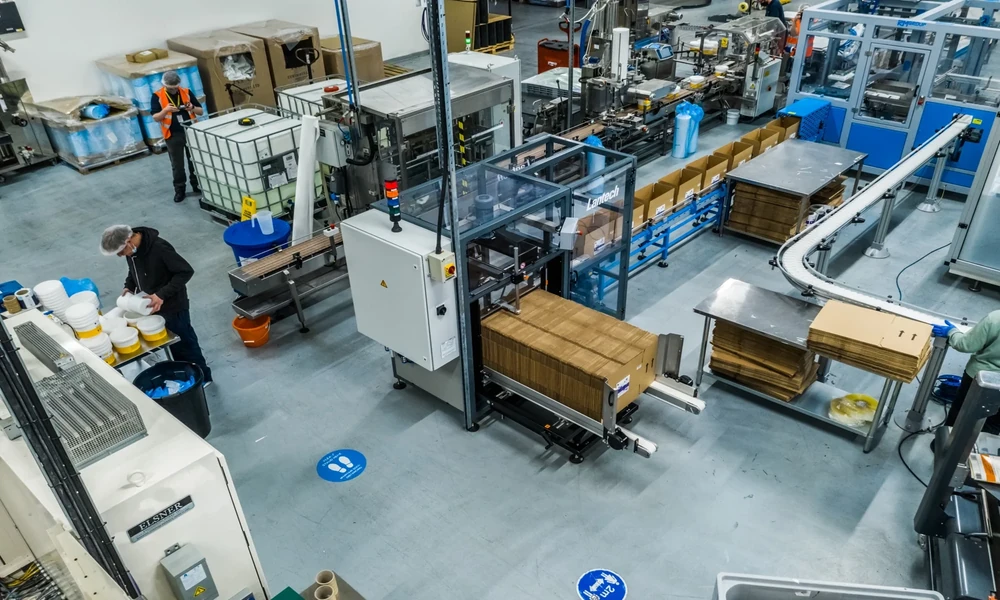
Manual handling at the final stages of a production line introduces significant operational variables. Even experienced operators face fatigue during repetitive shifts, leading to misaligned labels, incorrect item counts, or compromised structural seals on boxes. These subtle discrepancies quickly accumulate into expensive issues, resulting in rejected shipments, vendor chargebacks, and disrupted supply chains. When throughput demands increase, relying on human consistency alone becomes a significant operational risk.
Moving toward automated systems provides a structural answer to these compounding errors. By standardizing the physical handling and verification of goods before they leave the factory floor, facilities replace human variability with predictable mechanical precision. The goal is not merely to speed up the process, but to establish a reliable baseline of quality that remains constant regardless of shift patterns or labor shortages.
The Financial Impact of End-of-Line Discrepancies
A single mislabeled pallet or an improperly packed case triggers a costly chain reaction. When a distribution center receives an inaccurate shipment, the product is often set aside for manual inspection or returned entirely to the manufacturer. Beyond the immediate transportation and restocking fees, companies face strict penalties from major retailers who demand perfect compliance with their receiving protocols.
Frequent packaging defects damage distributor relationships and erode brand trust. If a retail customer receives damaged or incomplete product batches due to weak structural packing, the manufacturer bears the liability. Transitioning to automated packaging methods creates a protective buffer against these overhead leaks, ensuring that every box matches exact dimensional and weight specifications.
Standardizing the Workflow with Collaborative Automation
Traditional industrial automation often requires heavy, rigid fencing and a complete overhaul of the shop floor layout. For many facilities, a more practical approach involves collaborative robots and modular systems that integrate directly into existing lines. These systems handle tedious tasks like box erecting, case packing, and palletizing with unwavering repeatability, freeing human workers to focus on oversight and complex troubleshooting.
Setting up these systems no longer demands weeks of specialized engineering resources. Modern deployment platforms allow production managers to configure robotic cells for specific packaging tasks quickly. For instance, adopting an intuitive ecosystem like dploy packaging streamlines the integration of collaborative applications, making it straightforward to transition a line from manual sorting to automated packing without extensive custom programming. This type of accessible software helps maintain high uptime during product changeovers, as operators can adjust parameters via simple interfaces rather than rewriting complex robot code.
Verification Mechanisms and Machine Vision
Eliminating errors requires more than just precise motion; it demands real-time validation. Automated packaging lines frequently incorporate smart sensors and machine vision systems to inspect goods at critical checkpoints. These tools verify that labels are applied without wrinkles, barcodes are fully legible, and the contents of a box match the expected configuration.
If a defective package is detected, the system automatically routes it to a rejection lane for manual review, preventing the error from moving down the line. Integrating verification directly into the automated sequence removes the need for separate, time-consuming quality control steps. The result is a continuous feedback loop that flags upstream processing issues before they manifest as systemic packaging failures.
Mitigating Ergonomic Risks and Labor Strain
Manual case packing and palletizing are among the most physically demanding tasks on a manufacturing floor. Bending, twisting, and lifting heavy boxes over an eight-hour shift leads to cumulative strain injuries, which contribute directly to high employee turnover and absenteeism. When a line is understaffed or operating with temporary workers, packaging error rates inevitably spike.
Automating these repetitive movements stabilizes the production rhythm. Collaborative robots and specialized packers handle the heavy lifting seamlessly, ensuring that physical fatigue never dictates the speed or quality of the line. Operators can then be reassigned to higher-value roles, such as monitoring material supplies, auditing quality data, or overseeing multiple automated cells, creating a safer and more sustainable workplace culture.
Managing Product Diversity and High-Mix Environments
Many manufacturing facilities operate in high-mix, low-volume environments where product lines change frequently throughout the week. Under manual setups, changing over a line requires manual tool adjustments, physical retraining, and a high risk of initial errors as workers adapt to the new packaging requirements. This operational friction often slows down production schedules significantly.
Flexible automation addresses this challenge through programmable presets and quick-change end effectors. When a new batch requires a different box size or a distinct pallet pattern, operators simply select the appropriate recipe from a control panel. The mechanical components adjust automatically, ensuring that the first unit packed after a changeover meets the exact same standards as the last unit of the previous run.
Scaling Operations for Future Demands
Deploying automated packaging solutions creates a foundation for long-term operational resilience. As production volumes grow, automated cells can run continuously across multiple shifts without a drop in precision or an increase in defect rates. This predictability allows plant managers to forecast output accurately and commit to aggressive delivery timelines with confidence.
The shift toward automation also transforms the nature of factory floor labor. Workers move away from strenuous, injury-prone tasks like heavy lifting and repetitive taping into roles that involve system optimization and predictive maintenance. This shift improves workplace safety and positions the facility to handle future market fluctuations by relying on stable, scalable technology infrastructure.
